Collection of Mission Requirements
- We considered all the papers published in the software engineering, robotics, and formal methods venues from 2014 to 2019. We then use papers published in the software engineering, robotics, and formal methods venues in 2020 and 2021 for validation.
- We assigned the papers associated with a specific venue and years to one among the three authors that were assigned to the collection of mission requirements.
- The authors selected the papers satisfying the following criteria:
- The paper title contains a movement-related concern related to the robotic domain.
- The paper contains at least one formulation of a mission requirement involving a movement notion and also including a portion of the requirement related to one or more quantitative concerns, such as probability or time.
- Finally, the authors read the paper and collected all the natural language requirements involving movement notions and quantitative concerns.
missioncollection.csv: “Year”, “Link”, “Conference”, “Title”, “Mission”.
Identification of Mission Specification Problems
We subsequently identified mission specification problems starting from the mission requirements:
- We divided the collected mission requirements among three of the authors.
- Each mission requirement was labeled with two types of key-words:
- Key-words that describe the mission specification problems the robot has to achieve. Whenever a mission refers to one of the baseline mission specification patterns for robotic mission that are extended in this work, we use the name of the pattern as key-word.
- Keywords describing the quantitative behavior associated with the pattern.
- We created a graph structure representing semantic relations between keywords. Each keyword is associated with a node of the graph structure. Two nodes were connected if their keywords identify two similar mission specification problems.
- Nodes that were connected through edges and contained keywords that identify to the same mission specification problem were merged.
- We allowed each of the authors of this paper to propose additional mission specification problems.
mission-problem-identification.csv: “Year”, “Link”, “Conference”, “Title”, “Mission”. “Patterns”,“Keywords”.
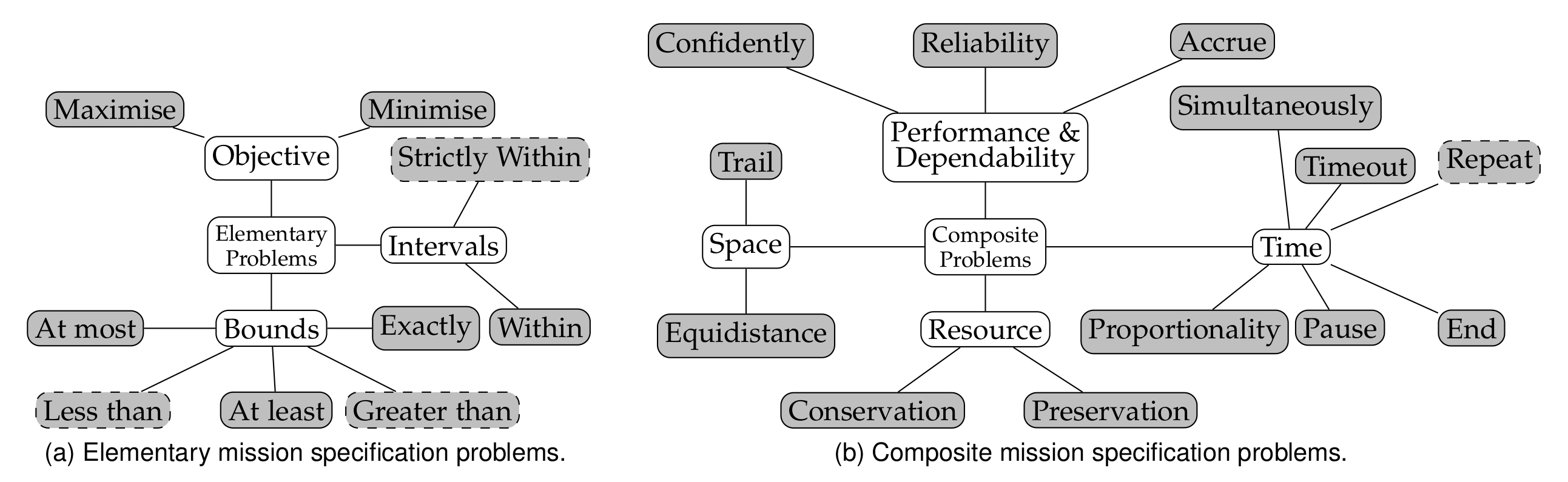
Finally, we organized the mission specification problems into a catalog represented through a graph structure that facilitates browsing among mission specification problems:
Pattern Catalog